The Power of Traverse + Grove
Health and human services work, leveled up from the office to the field.
It’s 4:45 p.m. on a Friday. A caseworker has six open referrals, three court summaries due Monday, and a family who’s been waiting two weeks for a placement update.
The paperwork isn’t going away. But the question of who carries it and what handles it changes everything.
That’s the idea behind Traverse and Grove (formerly Case Aide Services), Northwoods’ combined approach to health and human services software and support:
- Traverse, a modular software-as-a-service (SaaS) solution, organizes the documentation, case histories, and workflows that keep agencies compliant and clear-eyed.
- Grove is the expert human-staffed team behind the scenes, picking up administrative and operational tasks that eat into your day.
Together, they move faster. And they give your agency room to focus on the people and families you work for.
What Health and Human Services Support Looks Like When Technology and People Join Forces
Most agencies have some combination of tools and staff. It’s harder to find a system where the two hand off easily to each other. A documentation gap doesn’t sit in a queue. A completed task doesn’t need someone to go dig for it.
Traverse and Grove stand on their own. You can run Traverse as your platform without Grove. You can bring in Grove support without adopting Traverse.
Either way, you’re working with a partner built for this space. Traverse runs on HIPAA- and FedRAMP-compliant infrastructure. We rigorously train already-experienced Grove team members in health and human services documentation and workflows.
But for agencies weighing health and human services software and support, combining the two offers serious advantages. The Grove team works inside the same case histories and workflows Traverse tracks. Administrative and operational support doesn’t demand a separate system to check or handoff to manage.
They’re built with shared architecture by people who’ve done this work themselves (that’s us). Using both leads to one connected workflow, at your desk or in front of a family.
A Day in the Life: How Traverse and Grove Work Together
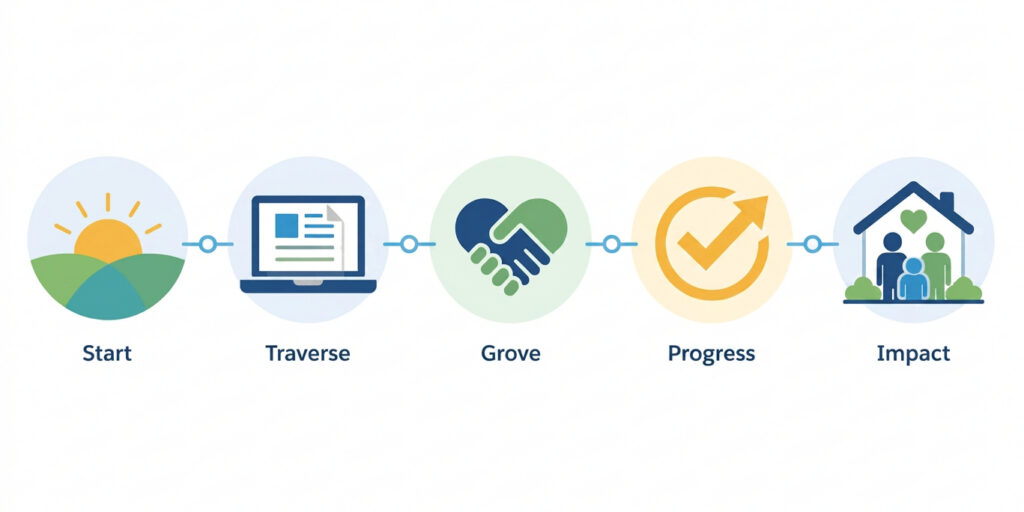
Imagine a kinship placement case. A worker logs into Traverse Monday morning and sees a flag: A required medical document is still missing. A court date is 3 weeks out.
She submits the request through intuitive Traverse modules. A Grove team member picks it up on the other side, reaches out to the medical provider, uploads the document, and connects it to the right case file. The worker receives a notification when it’s ready.
Meanwhile, her supervisor can see the request move from submitted to completed without asking anyone for status updates.
That’s the workflow: Traverse holds the structure and security, Grove supplies the hands and indispensable human review. The caseworker gets an afternoon back to meet with the family.
The Numbers Behind the Impact: Traverse + Grove
Agencies using Traverse and Grove have seen remarkable, measurable relief for frontline staff on both the technology and the support side. These are real results our agency partners have experienced.
- Grove
- Finishes more than 18,000 tasks for caseworkers across supported agencies
- Supports 240 unique staff members with everyday casework tasks
- Completes 43.2% of requests within 2 business days
- Handles each request thoroughly, with an average of 2.2 touches before completion
- Traverse
- Gives workers back roughly 2 hours in an average day
- Saves agencies up to $50 per worker per day in overtime and mileage costs
- Cuts turnover, saving an average of $54,000 per lost worker
- Turns months-long document signature timelines into a matter of days or hours
Behind each number is something your agency needs more of: time to think, plan, document safely, and be present. Time and clarity show up in four places across your agency’s operations:
- Workforce burnout
- Documentation and compliance
- Permanency and family stability
- Leadership visibility
Here’s what it looks like when Traverse and Grove are both part of the picture.
Where Traverse + Grove Reduce Burnout
Workforce strain is one of the most everpresent pressures agencies have. Turnover regularly costs 70% to 200% of an employee’s annual salary. The average turnover rate is 30%.
In child welfare programs alone, caseworkers stay on for just 1.8 years; they handle roughly 55 cases a year. It’s brutal. Those high caseloads, administrative demands, and limited time with families all pitch in to wear out staff.
Traverse reduces that burden by cutting the hours workers spend searching for files, tracking down signatures, and preparing for audits. Grove lessens it by taking on the administrative and operational tasks (referrals, records requests, documentation follow-up) that pile up around open cases.
Jackson County JFS saw that change. With Grove support helping workers document home visits faster, the agency raised its composite visit completion rate from 48.3% to 86% in one fiscal year. It was a 38% improvement that earned them a statewide Best Practice Incentive Award for workplace culture and worker well-being.
Less time lost to searching and documentation backlog leads to higher retention, lower costs, and more consistent services for families. Staff reclaim time, whether you’re leadership or a boots-on-the-ground caseworker.

—Sidney Forbes, Caseworker, Morgan County JFS
Where Traverse + Grove Strengthen Documentation and Compliance
Documentation errors carry intense financial weight. In fiscal year 2025, insufficient documentation accounted for 77.17% of Medicaid improper payments and 56.07% of CHIP improper payments. Aging systems, high caseloads, and staff turnover all widen that gap.
Traverse closes part of that gap by making documents searchable, complete, and connected to the right case. It cuts the duplicative entry and lost files that lead to noncompliant records. But a searchable system still depends on someone keeping it current, and that’s what erodes fastest under caseload pressure.
Grove picks up there. Real people process records requests, follow up on outstanding documents, and make sure nothing sits unfinished long enough to become a compliance risk.
Morgan County Job and Family Services saw that play out. The agency improved investigation timeliness by 44% after bringing on Grove support.
Stronger documentation reduces findings while protecting the federal funding tied to eligibility accuracy. And it gives supervisors one less reason to second-guess a case file under pressure.
—Josie Wells, Social Services Worker II, Morgan County Job and Family Services
Where Traverse + Grove Support Permanency and Family Stability
Permanency outcomes have consequences that outlast any one case. The national average length of stay in care runs around 22 months. Placement instability compounds the longer a case sits open. Frequent placement changes correlate to a higher risk of later involvement in the criminal legal system.
We know you want to change that. Traverse surfaces family connections and case histories, so you aren’t reconstructing a family’s story from scattered files before a hearing.
Clarity helps immensely, but someone has to act on what you find: following up with relatives, finalizing placement paperwork, prepping court summaries. Grove support turns visibility into progress.
Clinton County JFS saw this combination show up in their outcomes. With Grove, their teams reduced the number of children in custody by 10 over 3 months.
Fewer disruptions and faster permanency are better for case files, better for children’s life trajectories, and better for your caseworkers’ well-being.
—Hannah Webster, Child Welfare Manager, Mesa County Department of Human Services
Where Traverse + Grove Bring Clarity to Leadership
You can’t manage what you can’t see when you’re agency leadership. Balancing caseloads, catching high-risk cases early, and reducing backlogs depend on visibility. Without that, you end up reacting instead of preventing problems.
Traverse gives supervisors a direct view into case activity, task completion, and documentation quality. That means team caseloads and forms awaiting review are all in one place. You’re not hunting down workers via phone.
Grove extends your visibility to the support side: request volume, turnaround times, staffing patterns. Combined, you can spot bottlenecks and already know whether it’s a documentation or staffing issue.
At Wilson County Department of Social Services, that capacity appeared in day-to-day supervision. That means real-time feedback on in-progress forms, faster review cycles, and less time spent chasing status updates.
Clarity grows. Leadership isn’t operating on guesswork, and that means faster decisions, better risk mitigation, and more confidence walking into state or federal reviews.
—Brian Esch, Home and Community-Based Care Manager, Carver County Health & Human Services
Traverse vs. Grove vs. Both: The Health and Human Services Ecosystem
Here’s a breakdown of what Traverse software solutions and Grove support do, separately and as a duo.
| Factor | Traverse | Grove | Traverse + Grove |
|---|---|---|---|
| What it is | Cloud-based casework software that centralizes forms, files, and case documentation | A human-staffed support team that takes on operational and administrative tasks | Software and staffing working from the same case data, in constant communication |
| Core role | The system where case information lives, gets searched, and gets shared | An extension of your agency's team, absorbing the work that piles up around cases | Traverse holds the structure; Grove supplies the hands to act on what it surfaces |
| What it handles | Modularized document management, forms, case discovery, workflow tracking, reporting, and more | Records requests, referrals, visit documentation, court prep, and case analysis | Documentation is organized, and the follow-through gets done |
| Time given back | Meaningful daily time (~2 hours/day) recovered from searching, entering, and routing documents | Hours returned to caseworkers by offloading manual task completion | Time savings compound, with less searching and less doing |
| Visibility for leaders | Real-time insight into caseloads, activity, and documentation status across programs | Clear tracking of request volume, turnaround time, and task completion | Supervisors see both case-level detail and support-team capacity in one view |
| What it protects | Against lost files, duplicate entry, and compliance findings from incomplete records | Against tasks falling through the cracks and workers carrying more than they can without burnout | Against the layered risks (compliance, burnout, and outcomes) that build up when you don't catch and close gaps |
| How it shows up | A worker searches a case file and finds what they need in seconds or minutes | A caseworker submits a request and gets a meticulously completed task back | A flagged gap in Traverse becomes a closed task from Grove without weighing down workers. |
Bring the Power of Traverse and Grove to Your Agency
Less paperwork, more peoplework, in practice.
The Northwoods team didn’t build Grove and Traverse to take the place of people; we built it to make your days easier. Health and human services work is hard enough.
We’ve been in your shoes, and we pay attention to what you need from your tools and in-person support.
With Traverse and Grove in tandem, you protect your time, accuracy, and capacity to zero in on client relationships. That’s what brought you to the field in the first place.
See how scalable, purpose-built SaaS and hands-on help could streamline your agency’s workflows. We enjoy hearing from you.
FAQ: Traverse + Grove
Do I need both Traverse and Grove, or can I use just one?
No, they’re built to work independently. Many agencies start with one and add the other later, if at all. The difference shows up in the handoff. If you’re already running Traverse and add Grove, your support team works inside existing case histories: no separate system setup. Starting with Grove still delivers the same relief, just without that pre-existing digital paper trail to plug into.
How does Grove know what to work on if I’m not using Traverse?
Grove runs on its own request system (secure portal, mobile app, phone, and text) independent of any case management software. You set the task and the deadline; Grove works from the documentation and systems your agency already uses. Traverse removes a layer of friction by giving Grove direct access to the same case file, omitting back-and-forth manual routing.
Is Traverse still compliant and secure if I use it without Grove?
Yes. Traverse’s HIPAA and FedRAMP compliance, encryption, and AWS infrastructure are built into the software itself. Grove doesn’t add or subtract from that. Compliance lives with whichever product holds your data.
What programs and agency types use Traverse and Grove together?
Child welfare and adult & aging are the biggest overlap today, with support reaching into more specialty areas. Grove helps with developmental disability and behavioral health, Traverse with child support and economic assistance. We’re continually expanding both. If your agency falls outside these categories, we can most likely tailor Grove and Traverse to fit it.
How quickly can my agency get Traverse and Grove up and running?
Traverse implementation averages 90 days or fewer. It comes with a dedicated project manager, business process discovery, and full training rollout. We can integrate Grove support into your agency in 90 days or fewer, with dedicated team members available through a portal and app, plus phone and text.
Let’s Get Started
Talk to a Northwoods social services expert to explore how our solutions can modernize your human services agency.